
Welcome to Inspirado, a collection of practical English and Spanish learning resources, travel writing and cultural notes. Explore language guides, read about destinations across Latin America and find ideas for making steady progress one small step at a time.

One language, many voices: Spanish across Latin America
Spanish is spoken as a first language by more than 450 million people, and no two countries sound quite alike. A learner who studies in Guatemala, moves on to Colombia and then spends a few months in Ecuador will hear different pronouns, different everyday words and a different rhythm in each place. That variety can feel confusing at first, but it is also one of the pleasures of learning Spanish on the road: every new town gives you a few words that locals are proud to call their own.
The good news is that the core of the language is shared. Grammar, most vocabulary and the written standard are very close from Mexico to Chile, so what you learn in one country carries over to the next. The differences sit mostly in how people address each other, in a handful of everyday nouns and in local slang, and those are easy to pick up once you know to listen for them.
Tú, vos and usted
The biggest surprise for many learners is the pronoun vos. Textbooks often teach only tú for "you" when talking to a friend, yet in Argentina, Uruguay, Paraguay and much of Central America, including Guatemala, people use vos instead, with its own verb forms: vos tenés, vos sabés, vos podés. If you take classes in Antigua or Xela, your teacher will probably use vos with you outside the textbook, and it is worth learning to recognise it early.
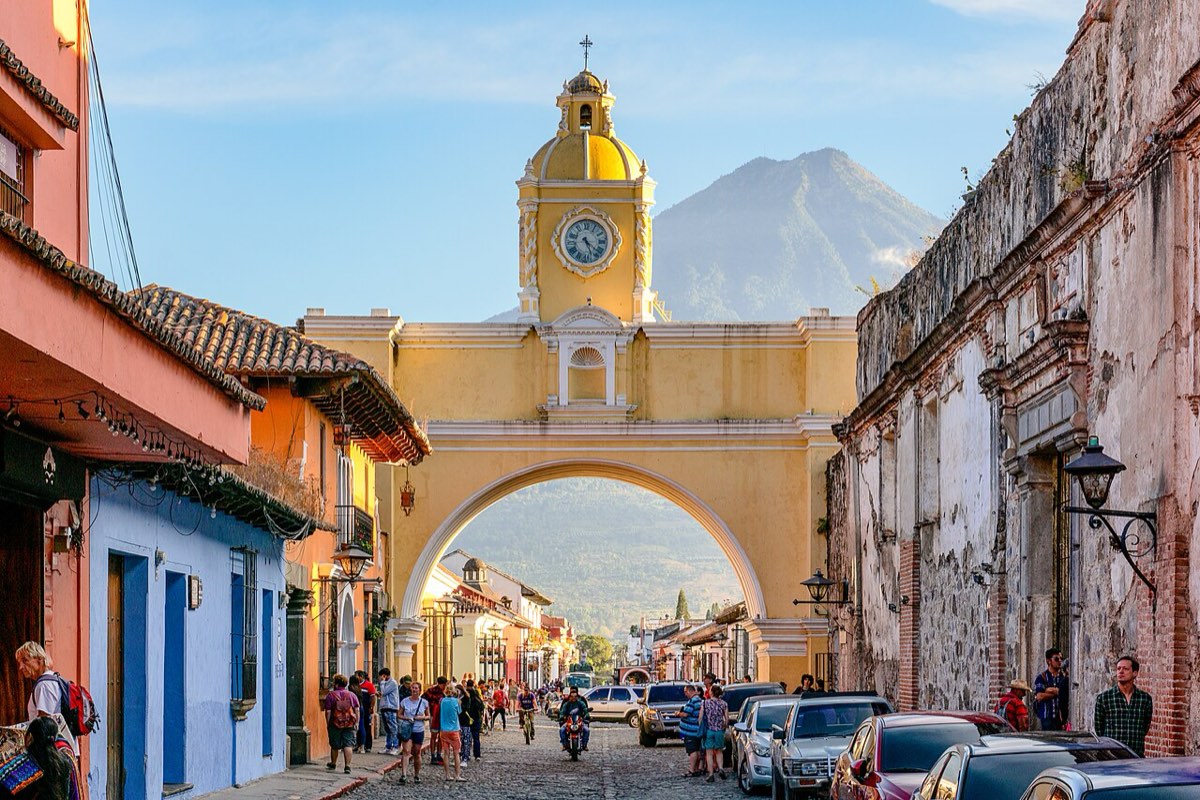
Colombia adds another twist. In Medellín and the wider Paisa region you will hear vos among friends, but usted, the formal "you" in most textbooks, is also used warmly between friends, couples and even parents and children. Meanwhile, all of Latin America uses ustedes for "you all", so the vosotros forms that Spanish courses from Spain practise are something you only need to understand, not produce, if your plans lie in the Americas.

The same thing, different words
Everyday objects are where regional vocabulary shows most. A bus is a camión in Mexico, a camioneta for Guatemala's colourful "chicken buses", a colectivo or buseta in other places, and a guagua in Cuba, Puerto Rico and the Canary Islands. In highland Ecuador, though, guagua means a baby, a word borrowed from Kichwa, the Andean language that has also given Ecuadorian Spanish chuchaqui for a hangover and achachay for "brr, it's cold". In Mexico, ahorita can mean "right now" or "some time later", depending on tone, and ¿mande? is the polite way to ask someone to repeat themselves.

How to handle the variety
The simplest strategy is to choose one variety for speaking, usually the one you hear most, and aim to understand the others. Keep a small notebook of local words with the place you learned them, and when a word puzzles you, ask: ¿cómo se dice aquí? People almost always enjoy explaining their own expressions, and the question often turns into a real conversation. Listening to radio or podcasts from several countries, even for ten minutes a day, trains your ear to switch between accents.
Most of the travel posts in this archive were written while learning these differences the hard way, from Antigua Guatemala to Medellín and Cuenca. Read them alongside the lessons on the Learn Spanish page, and you will start to notice how much a single word can tell you about where someone is from.
Learn languages through everyday use
Language learning becomes more manageable when practice is connected to real situations. Use the English and Spanish articles to review grammar, build useful vocabulary and try short speaking or listening activities. Begin with a beginner-friendly question, follow a topic that interests you or revisit a familiar lesson with a new goal. The resources include examples that show how a phrase works in context, so you can adapt it for your own conversations.
If you are studying Spanish, start with a simple weekly routine: listen to a short dialogue, write a few sentences, read something brief and say one idea aloud. If English is your focus, choose a practical situation such as introducing yourself, asking for directions or explaining a plan. Repetition helps more than a long session that is difficult to repeat.
Read travel stories with context
The travel section follows places and experiences in Colombia, Guatemala, Mexico, Ecuador, Peru and other parts of the region. These articles combine observations with practical questions about routes, local customs and daily routines. They can help you prepare a reading list or understand a destination’s background. Always confirm current transport, safety and opening details with local or official sources before travelling, since conditions can change.
Responsible travel begins with attention. Learn a few local phrases, ask before taking photographs, respect community spaces and leave time to notice ordinary parts of a place. A walk to a market or a conversation over a meal can be as memorable as a scheduled attraction.
Explore the collection
- Browse English learning resources for lessons, grammar and teaching ideas.
- Read Spanish learning resources for vocabulary and conversation practice.
- Visit the blog for recent guides and structured how-to articles.
- Use the HTML sitemap to find a page by topic.
Inspirado is a readable archive for curious learners and travellers. Pick one subject, follow the related links and return whenever you are ready for the next useful idea. The pages bring together practical exercises and personal observations so readers can move between study and wider cultural context.
Find a useful next step
If you have only a few minutes, open one lesson and practice a single example aloud. If you are planning a journey, choose one destination article and make a note of the questions that need current local answers. The related reading sections connect subjects across the collection, while the blog highlights recent guides that combine explanations with examples and planning tables.
Different readers arrive with different goals, so the collection is organized to support browsing as well as direct answers. Use the page titles and related reading links to move between connected topics. You can return to a lesson later and repeat an example, or save a travel article as background for further research. The aim is a useful starting point for learning and exploration.
Where these notes come from
Most of the archive was written on the road rather than at a desk. There are three months of teaching English in Cuenca, Ecuador, classes in Perú where every student called the instructor simply “Teacher”, Spanish lessons at Pop Wuj, a teacher-run cooperative school in Quetzaltenango (Xela), a family homestay in Antigua, and a slow settling-in between Medellín and the hill town of Marinilla. Shorter stays in Puerto Vallarta, Guadalajara, Nicaragua and Málaga filled in the gaps.
Those older posts are kept as they were written, mistakes and all. A missed bus stop or a conversation that went sideways in the wrong tense often teaches more than a polished lesson, and for anyone heading the same way, the small frustrations are the useful part.
Classroom habits you can borrow as a self-taught learner
Time spent teaching English is also a crash course in how adults learn any language. The habits that work in a good ESL classroom carry straight over to studying Spanish on your own, and the reverse is just as true for Spanish speakers learning English.
| What a good teacher does | How to do it for yourself |
|---|---|
| Keeps material just above the learner’s level | Choose podcasts and readers where you understand most of what you hear, not every word, and not almost none. |
| Limits teacher talk so students speak more | Count your own speaking minutes each week. A 20-minute call with a tutor or exchange partner usually beats an hour of passive review. |
| Treats errors as information | Keep a short list of the mistakes you repeat and pick one to fix each week instead of trying to fix everything at once. |
| Recycles vocabulary across lessons | Reuse new words in a few sentences of your own within two days, then again a week later. |
Stumbling blocks worth knowing in advance
English speakers learning Spanish tend to trip over the same few points. Ser and estar both translate as “to be”, but one describes what something is and the other how or where it is right now, so está aburrido means bored while es aburrido means boring. Por and para take patience; it helps to learn them through set phrases such as por favor, por la mañana and para mañana before working through the rules. The subjunctive mood feels strange at first, yet it turns up in everyday requests like quiero que vengas, so it is worth meeting early. False friends cause the funniest moments: embarazada means pregnant, not embarrassed, and actualmente means currently.
Spanish speakers learning English face a different set. The present perfect (“I have lived here for two years”) has no exact match in everyday Latin American Spanish, phrasal verbs such as “look up”, “look after” and “look forward to” change meaning with one small word, and the past-tense ending -ed sounds three ways, as in “worked”, “played” and “wanted”. Questions also need a helper verb: “Do you like coffee?” rather than “You like coffee?”. The verb tense chart on the Learn English page sets English and Spanish tenses side by side, which makes these gaps easier to see.
Choosing a place to study Spanish abroad
Immersion works best when the setting suits how you learn. Guatemala, especially Antigua and Xela, has a long tradition of one-to-one tuition, often paired with a family homestay at modest prices. Colombia’s Paisa region and highland Ecuador are often described as having clear, unhurried speech that beginners find easier to follow. Mexico offers almost every kind of town, from beach resorts to colonial cities like San Miguel de Allende. Wherever you go, spend more of the day in Spanish than in English. A school that teaches well but sends you home to a hostel full of English speakers gives you only half the benefit.
Before booking, check current safety guidance, visa rules and whether a school’s schedule leaves time for real conversation outside the classroom. Then, once you arrive, aim for one conversation a day that you could not have managed the week before.
Frequently asked questions
Is Inspirado for English learners or Spanish learners?
Both. Most articles are in English and aimed at people learning Spanish or teaching English, while the Learn English page and several Spanish-language posts are written with Spanish speakers in mind.
Are the travel stories still accurate?
Treat them as dated first-hand impressions, not current instructions. Prices, routes and safety conditions change, so confirm practical details with local or official sources before you travel.
Where should a complete beginner start?
Start with the weekly Spanish routine, then use the Learn Spanish page to choose one skill to focus on. Short daily practice beats occasional long sessions.
Can I download the verb tense charts?
Yes. The Learn English page links to a free spreadsheet that lists English and Spanish verb tenses with examples, useful for learners in either direction.